¿Cómo podemos ayudar?
How to add the measurement function to my 3D Models
In order for the measurements function to be displayed inside your virtual tours, you need to add the action "3D Model / Measurement" to any element of the tour (e.g. a skin button, a hotspot, etc…)


When you select the measurement action, you'll see that there is a number of sub-actions to control the measurement tool. The most straight forward ones would be "Start" and "Stop", but there are many more and depending on the desired configuration, we may want to create several buttons with different functions (unless you want to use a toggle button).
- Start: Starts the measurement mode. When the visitor clicks a button with this function, it'll start measuring between two or more points that the user clicks on in the virtual tour.
- Stop: Click this button to stop the measurement mode and return to normal navigation (clicks won't initiate measurements).
- Toggle Start/Stop: For the same button to act in toggle mode ("On/Off", so that the first click starts the measurement, and the second click stops it.
- Clean All and Clean Selected: To delete the measurements made, either all or only the selected ones.
- Show and Hide: Shows or hides the measurements made (but does not delete them like the previous sub-action).
- Toggle Show/Hide: the same as the previous one but to be used in a single button that acts as a toggle.
- Set Metric Units and Imperial Units: Changes the unit of measure that is displayed in the measurements.

We can then further configure the measurement tool to adapt it functionally and visually to our needs. For this, we have an options panel that is displayed when selecting "Start".
- Unit: Pre-define the unit of measurement "Metric or Imperial"
- Allow Multiple Segments: Activate this if you want to allow visitors to take measurements between more than two points, with multiple linked segments so as to place several points and see the distance between them. If deactivated it will only allow measurements between two points.
- Display Distance, Partial Distance and Area: Define whether or not to show this information in the measurements.
- At End launch action: Allows you to launch a defined action as soon as the measurement is finished (upon double clicking or pressing esc key -this is independent of the action "Stop measurement"-). This allows you, for example, to display a text box or hide the measurements made automatically when the user finishes the measurement.
After these functional settings we have all the options to visually configure our measurements.
We can change the font, size and color of each of the texts with the measurements that appear when measuring (Global, Distance, Partial Distance and Area). We can define whether they should be resizable texts (for better responsiveness) and even change the color of the background on which those texts are displayed.
We can also change the color and some other settings of the visual indicators of the measurements such as the Area, the points that determine the segments and the lines.
Important: Set the correct scale of your 3D Model
Before using the measurement tool, it is important to make sure that your 3D model has been correctly scaled. Otherwise, the measurements displayed in the virtual tour may not correspond to the real dimensions of the model.
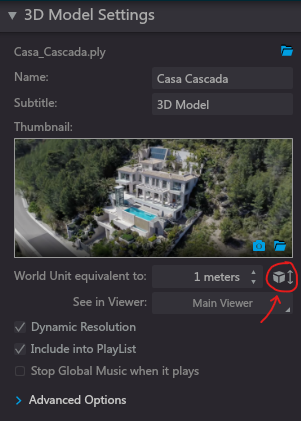
When you import a 3D model, 3DVista does not automatically know its real-world scale. Therefore, you need to define the scale of the model first. You can do this from 3D / Settings, in the right panel under 3D Model Settings, using the "World unit equivalent to" option.
You can enter the value manually, or use the button next to "Measure in 3D Model" (the cube with the arrow). This allows you to measure a known element of your model and assign its real-world dimension to it. For example, you could measure the height of a door in your model and, if you know that the real door is 2 meters high, assign a value of 2 meters to that measurement. Once you do this, the "World unit equivalent to" value will be automatically defined. You only need to perform this calibration once, and from that point onwards, the entire 3D model will be correctly scaled to real-world dimensions.
This step is essential if you want the measurements created with the Measurement action described above to correspond accurately to the actual dimensions of your 3D model.